Showing posts with label Sri Lankan food. Show all posts

Sunday, 16 August 2015

Koththu roti - Ammi's version of it

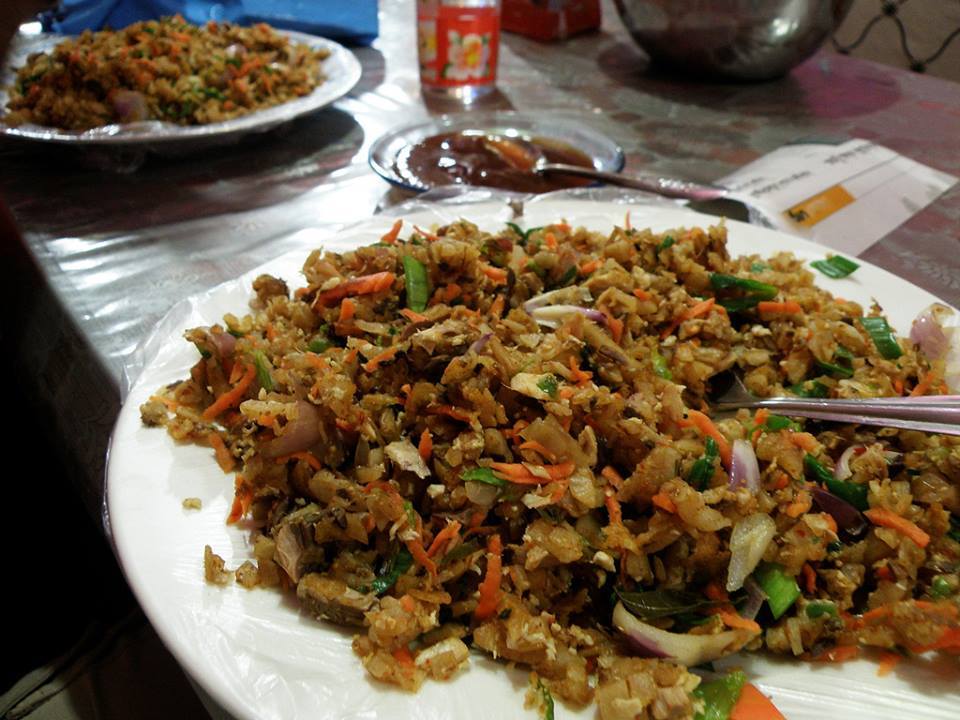
Koththu roti - photo credit Pearl of Indian Ocean - Ceylon Facebook page with permission

 
Koththu roti is a very common Sri Lankan food which is made using chopped up Godamba rotis (thin flour based roti tissues) chopped up finely, a handful of vegetables, fish, chicken or meat and the addition of an egg or two and a few sauces.  It has its origins in Malaysia I am sure as Godamba rotis are a version of the Malaysian roti tissue. However, it is now a Sri Lankan dish and we all love it.

Makinng Godamba rotis and then making Koththu is the correct way to do it but I don't have the time nor the patience to do it. So I have derived the easy or the cheat's way to do it.

I use wraps from the supermarket as a fair substitute. The thinner the wraps are, the better. I also don't own one of those metal trays that are traditionally used to make koththu which makes the Koththu sounds when the Koththu cooks make a racket with two cutters that they use to mix everything up.

Traditional way to make Koththu - Photo credit Pearl of the Indian Ocean - Ceylon (with permission)
 
I use my faithful wok to create koththu and although the sound is missing, normally when I make koththu, not a morsel will be left over with my family and friends.

This is my trusted recipe to make Koththu Roti at home especially if you live outside of Sri Lanka and have no access to buying Godamba rotis.

These days, we are able to buy Godamba rotis in packets of 4 or 5 for about $5 in Auckland shops. We even have a Roti Hut opened by a Sri Lankan but not everyone may have access to it as we did a few years ago.

Ingredients:

Serves 4-6

4-6 wraps (the kind that are used to make rolled wraps), cut them into fine pieces with kitchen scissors (about 1" (3 cm) in length and 1/4 " 1 cm) in width or as fine as you can or if you can find them 5-6 plain godamba rotis cut into pieces

2 boiled potatoes, cut into small cubes
2 boiled carrots, cut into small cubes
1 leek chopped finely
1 red and 1 green capsicum or banana chillies (maalu miris) if you can get them, cut into long strips
a handful of cabbage leaves cut finely
1-2 tomatoes chopped
2 red or white onions, sliced finely
3-4 green chillies sliced
a handful of curry leaves
4 cloves of garlic, crushed
1 small piece of ginger, peeled and grated or crushed
Cooked chicken/ beef or fish (you can use left over curry as I do, cut into bite sized pieces)
4 eggs, whisked lightly and seasoned with salt and pepper
a choice of any sauces that you have : tomato/chilli/soy/fish/Worcester sauce
about 3 tbsps. oil + an additional 1 tbsp.
salt, ground black pepper and chili powder to taste (about 1 tsp each if you must want exactly quantities)


Method:

Heat oil in wok and swirl around to cover the sides. When hot, add the curry leaves and the onions and green chillies and sauté for a minute. Add the ginger garlic pastes, and stir fry till the onion is transparent but not brown. Then add the leeks and stir fry for another minute and then the other vegetables and fry on high heat for a minute or so. Add the potatoes and carrots and then the chopped up wraps or roti pieces. Lastly add the tomatoes. Stir fry using two spoons or fish slices quickly. Add the fish or meat or omit it for vegetarian koththu.

Make a space in the centre of the wok and pour the extra 1 tbsp. oil into this. Let it heat for a few seconds.  Add the eggs into this space and quickly stir fry to lightly scramble egg. Then mix it all up and season with any sauces and check seasoning. Add more salt, chili powder and pepper if you want more spice.

Serve immediately and enjoy.

Ammi's tips:
  • I serve it as dinner but you can use it as a snack or a weekend lunch. Left overs, if any, make a lovely lunchbox.
  • There are no hard and fast rules about the vegetables you use. Use whatever is in your fridge. Its a great dish to use those odds and ends in the vegetable compartment of a fridge. I have used mushrooms, courgettes, beans, tomatoes etc. with great results.
  • If you are using just bland  cooked meat, add a spoon of curry powder
  • Usually when I buy a packet of wraps usually one or two could be left over. If this happens, I chop it up and put into a freezer bag and use frozen bits of wraps for koththu on days when I don't feel like doing much cooking.


Sunday, 9 August 2015

Filled godamba rotis - Sri Lankan street food

I need to make some Sri Lankan finger food for a gathering. I usually make my tried and tested fish buns or maalu paan for it but this time around someone else has agreed to make it and I wanted to make something that is not too difficult and decided to try my hand at making filled godamba or gothamba rotis.


For those of you who are not too familiar with Sri Lankan food, godamba rotis probably have their origin in Malaysia or Singapore or thereabouts as I have come across similar roti tissues in that part of the world. However, as we do, we Lankans have adopted this item and made it our own. We fill the tissues with fiery fish, meat and vegetable fillings and call them maalu roti (fish roti), mas roti (meat roti) or elavalu roti (vegetable roti).  They are a popular street food and it is common to see them in many a street food stall or roadside tea house to be washed down with a cup of hot sweet plain tea.

I learnt how to make godamba roti from our Appu (cook) Arunasalam and he could whip up a batch of these rotis in no time. He painstakingly showed me how to flip the rotis on a flat griddle to create gossamer thin, translucent tissues by the flick of his wrist. I mastered the art then but with a fractured wrist that has become weak, I am not able to achieve this anymore. However, I can make passably good roties by flattening them down on a normal cutting board.

Ingredients:

 4.5 cups of plain or all purpose flour (250 g x 4.5 =  gms)
1 tsp salt
1 tbsp cooking oil ((I used rice bran oil)
Cold water (approximately ml)
an extra half cup of oil to soak the dough balls

Place the sifted flour in a large bowl and make a hole in the middle. Add salt and oil and bind with water to make a stiffish dough adding sufficient water. Knead well for 5 minutes or until the dough is springy (like bread dough).

Make into small balls and place in a bowl with the oil and swirl around to coat the dough balls with oil. Cover with cling wrap and leave for at least half a day or overnight.

Meanwhile make a filling using flaked canned or cooked fresh fish/mince or finely chopped chicken or a vegetable filling.

Basic veggie filling:

Boil 3 potatoes, peel and mash roughly. Saute about 2 chopped onions, a couple of green chillies, a few curry leaves in a tablespoon of oil. Add some ginger garlic paste and stir fry for a minute. Add your choice of chopped vegetables such as chopped leeks, parboiled and grated carrot, finely shredded cabbage leaves etc. and stir fry. Season with a little ground turmeric, unroasted curry powder and season with salt and pepper. Add the boiled potato lastly and mix well. You can add some Worcestershire sauce or tomato sauce if you like.

You can add cooked flaked fish or cooked meat to this mixture to create a fish or meat filling too or chopped hardboiled eggs.

Heat a griddle or a flat bottomed frying pan on medium heat and grease with melted butter or oil when heated.

Take one of the dough balls and using your oil smeared hands flatten each ball out into a thin tissue on a work surface or board. Place a heaped tablespoon of filling and fold the sides to envelope the filling and create a square, oblong or triangular shape and tucking the ends in. Place on the hot griddle and cook until lightly browned and turn over.

Repeat with all the balls and cook all 4 sides of the rotis, stacking them as you go.

Once cooked serve them on their own or with a sauce on the side.

I didn't take photos of my end product so borrowed this photo from the Pearl of the Indian Ocean Facebook page. Thank you for that.


Saturday, 6 December 2014

Welcome to Asoka's Sri Lankan Kitchen

Ayubowan! Vanakkam! That is hello to you in Sinhala and Tamil, the two languages of Sri Lanka.

I was born in Sri Lanka although I have lived out of that beautiful island for more than half of my life leaving the country as a teenager.  However, I've always had a keen interest in cooking the food of my motherland even when I lived in countries where there were no Sri Lankan food items available for sale.
Currently I live in Auckland, New Zealand which has now become a really diverse city where we can lay our hands on most ingredients to cook Sri Lankan. It wasn't like this when I moved to NZ two decades ago when we had to go to the city to the one Indian shop where I would buy coriander, cumin and fennel seeds to make my own curry powder.

I know how hard it can be to produce our food when you live overseas. When I was a student in a foreign university, there were no spices that could cook our food unless our parents sent them in food parcels and we guarded those spices stingily until our next overseas trip to London where we could stock up on spices, Maldive fish and even dried curry leaves.

When I am creating recipes, I keep in mind people who may not have the luxury of obtaining a lot of the ingredients to create the tastes of Sri Lanka. Therefore, I will use substitutes and sometimes make stuff from scratch and provide hints to the amateur cook or the non Sri Lankan who would like to try their hands cooking Sri Lankan.

There are hundreds of cooking sites, many cook books and recipes online and I didn't want to start yet another blog on Lankan cooking.  The other day, I was gifted a Sri Lankan cookbook which I grabbed gleefully. However, on turning the pages, I found butter chicken, Tandoori chicken and korma within the first chapter and was saddened that Indian staples are passed off as Sri Lankan. On another occasion, a friend and I saw a sign advertising Sri Lankan lumprice at a food fair and were horrified when the man lined a foam container with a strip of banana leaf and served some yellow rice, a brinjal curry, a boiled egg and a chicken drumstick and a cutlet with seeni sambal from his rice and curry stall and passed it out to non suspecting expats as lumprice. My setting up this blog was to dispel such incorrect portrayal of food as authentic Sri Lankan.

I am not a trained chef but I have cooked since I was a teenager growing up in the suburbs of Colombo, learning from my mother and my aunts who were wonderful cooks. I also learnt cooking from some great ladies who conducted cookery classes such as Mrs Soma Gunawardena, Mrs Dickman and Mrs Mallika Joseph.  They taught me how to cook elegant dinner party food and make cakes.

Later, I conducted my own cooking classes  to my work colleagues and also taught Wilton cake decorating at my cousin Wasantha De Silva's famous cookery classes held in Gampola. After leaving the shores of Sri Lanka, I underwent some cordon bleu training in the UK and took cake decorating classes in Canada. Most of my knowledge comes from self learning and experimenting. I wrote a cookery column "Food Around the World" for Lanka Woman, the then only English language weekly for women in Sri Lanka. I had a page on the Ammas.com website (click on link) since 2000 which was very popular and I was on the Council of Ammas for cooking, lifestyle and marriage. I have blogged about crafts, gardening and healthy food before.

The purpose of this blog is to contribute my experience as a hobby cook, a food writer for a few decades and an enthusiastic foodie who wants people outside of Sri Lanka to cook authentic Sri Lankan food that their mothers, grandmothers and family members cooked. I was inspired by the generations of my daughter and grand daughter who may one day want to cook the foods of their childhood.  I also want non Sri Lankans all over the world like my Dutch son in law, my Aussie nephew  and my Kiwi soul mates Angela and Kiran who enjoy Lankan food to experiment with the wonderful tastes of Lankan cooking.

I hope you will join in my journey in experimenting with authentic Sri Lankan cooking.